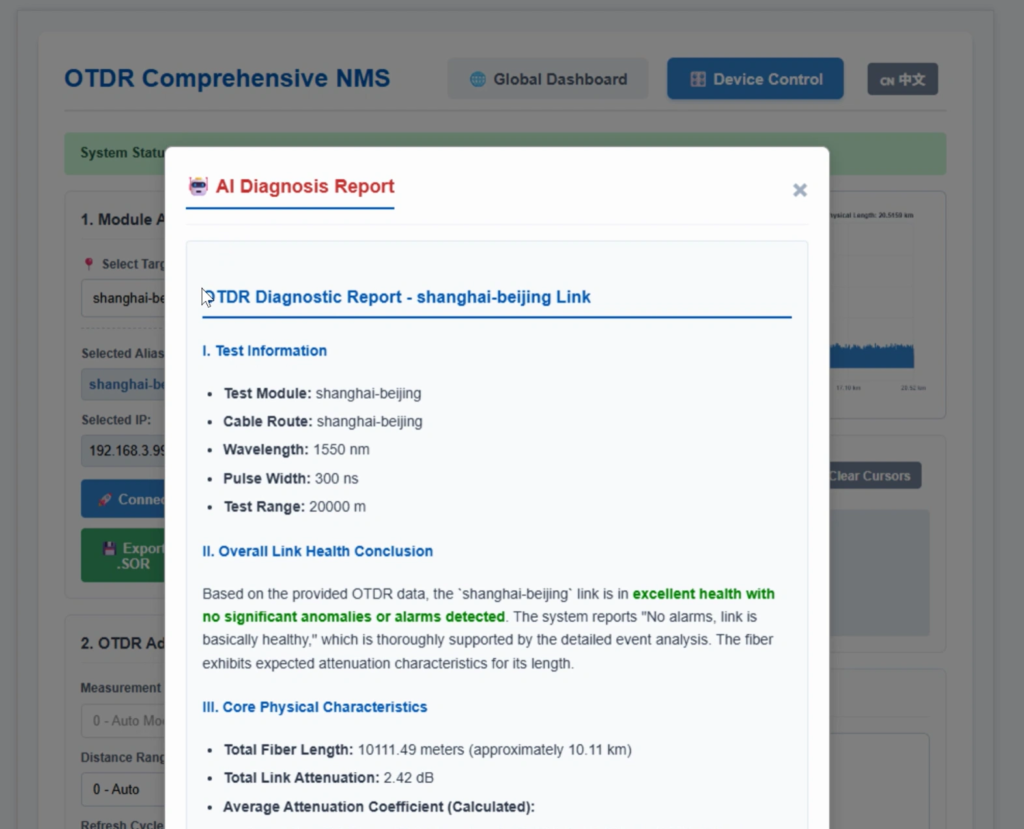
FirstFiber Technologies has officially released an automated AI diagnostics module for its Optical Time-Domain Reflectometer (OTDR) Network Management System (NMS). Powered by Gemini models, this integration transforms raw reflectometry telemetry into structured, actionable engineering reports in real time.
The Operational Challenge in OTDR Analysis
Standard OTDR measurement yields complex backscatter traces containing reflection spikes, splice losses, and attenuation bends. Interpreting these traces requires experienced field technicians to distinguish genuine fiber faults from measurement artifacts such as ghost reflections.
As optical networks expand in scale and density, manual trace analysis creates operational bottlenecks, extends Mean Time to Repair (MTTR), and increases reliance on specialized field engineers.
Key Capabilities of the AI Module
1. Structural Trace & Event Parsing
The module ingests raw physical layer data—including pulse width, measurement wavelength, sample spacing, refractive index (IOR), and multi-point loss events—and performs automated analytical cross-referencing against configured parameters.
2. Automated Artifact Filtering & Topology Corroboration
By combining NMS baseline templates with Gemini’s contextual processing, the engine filters out false positives such as echo ghosts while accurately flagging critical physical deviations (e.g., macrobends, connector degradation, or sudden fiber cuts).
3. Actionable Field Repair Directives
Instead of displaying raw numerical metrics, the engine outputs structured diagnostic reports directly in HTML format. Reports provide:
- Overall optical link health status
- Core physical metrics summary (distance, cumulative loss, attenuation coefficient)
- Location-specific fault identification and field repair recommendations
Technical Workflow & System Architecture
[OTDR Hardware] ──(TCP/IP)──> [NMS Core Parsing] ──(Serialized Data)──> [Gemini API] ──(HTML Report)──> [NMS Operator Dashboard]
- Data Acquisition – The OTDR NMS retrieves loss and event trace arrays directly from field hardware.
- Baseline Comparison – Event tables are compared against stored route templates to isolate anomalies.
- AI Processing – Structured parameters (wavelength, pulse width, alerts, event locations) are serialized into a standardized prompt payload.
- Report Rendering – The response generates a diagnostic summary with onsite guidance within seconds.
- Configuration & Deployment
The AI module is natively integrated into the latest OTDR NMS software suite. Administrators can activate automated analysis by navigating to Expert System Config (Gemini) within the control panel and entering their API key.
For comprehensive technical specifications or software updates, contact technical support.