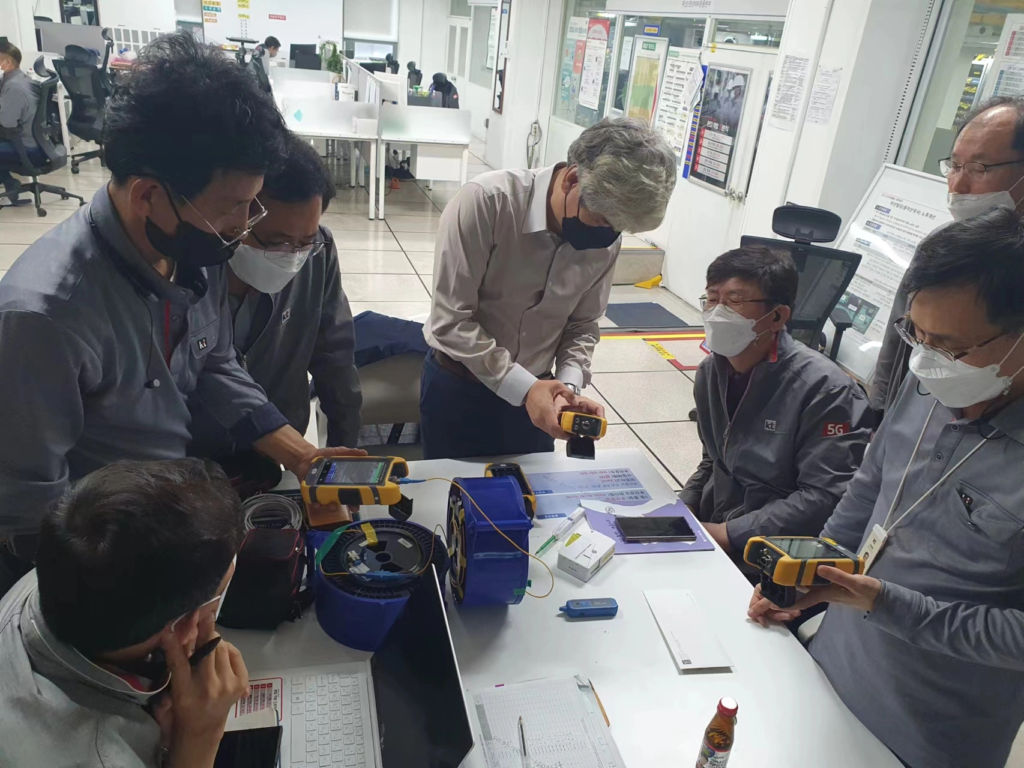
Snapshot
- Customer: KT Corporation, South Korea’s largest telecom operator; large-scale commercial testing phase for 10G PON
- Scenario: 10G PON coexists with legacy GPON; the same fiber carries a 1490nm downstream signal
- Core challenge: Standard 1625nm OTDR live testing produced false events in the trace due to Raman noise and filter crosstalk, making it impossible to reliably locate connectors, splices, and splitter ports
- Deliverable: Custom 1650nm OTDR (980EXP-B26 platform), integrated into KT’s automated fiber monitoring system
- Results: Zero service interruption during live testing; dynamic range >37 dB; event dead zone <1 m; first batch passed KT acceptance testing on the first attempt
Who the Customer Is
KT is South Korea’s largest telecom operator and is at the forefront of global broadband network innovation. While advancing large-scale testing of next-generation 10G PON, KT’s live fiber also carries existing GPON services, with a 1490nm downstream signal already transmitting on the fiber. This means any live testing method must work without interrupting service.
Starting Point and Constraints
KT initially used the industry-standard 1625nm OTDR for live evaluation, but the results were unusable: when 1625nm probe light and the 1490nm signal travel on the same fiber, Rayleigh backscatter and residual 1490nm light overlap. In addition, Raman noise caused by the close spectral spacing fills the trace with false events and a high noise floor, making it impossible to reliably locate connectors, splices, and splitter ports.
The constraints therefore became very clear: the test wavelength must completely avoid all revenue-generating signal bands; it must penetrate splitters up to 1:64; and it must integrate into KT’s existing automated fiber monitoring ecosystem rather than exist as an isolated instrument. KT’s chosen answer was 1650nm—at this wavelength, isolation from 1490nm, 1577nm, and 1270nm signals can be complete. But at the time, no off-the-shelf 1650nm OTDR met both the required dynamic range and field ruggedness.
Specifications and Scope
Customer Requirement Actual Delivery
- Wavelength: complete isolation from 1490/1577/1270nm signals Custom 1650nm OTDR with narrow-linewidth laser source
- Dynamic range: benchmark against top-tier 1625nm instruments >37 dB
- Event resolution: suitable for dense street cabinets and MDU cabling Event dead zone <1 m
- Live testing: zero service interruption Validated on KT’s live 10G PON test bed
- Integration: connect to KT’s automated fiber monitoring system Seamlessly integrated into KT’s monitoring platform
- Field safety: Class 1 eye safety Meets field use requirements
Process
Phase 1: Engineering breakthrough—making 1650nm “usable“
At longer wavelengths, Rayleigh backscatter is slightly lower while fiber attenuation is slightly higher, directly compressing dynamic range. FirstFiber responded in three areas: it developed a narrow-linewidth 1650nm laser source with outstanding output stability, maximizing launch power while maintaining Class 1 eye safety; it customized the optical front end, combining a low-noise avalanche photodiode with multi-stage amplifiers to improve weak-signal detection after high-loss splitter links; and it used proprietary algorithms to suppress coherent noise and dead-zone artifacts, making traces repeatable and event resolution clear in dense cabling scenarios.
Phase 2: First delivery—passing acceptance on the first attempt
After months of prototype iteration and laboratory validation, the first batch of 1650nm OTDRs passed KT’s acceptance testing on the first attempt.
Phase 3: Field deployment and two customer-driven iterations
After the devices entered KT’s urban, suburban, and MDU live 10G PON test beds, the core metrics were validated: zero service interruption during live testing, event dead zone <1 m, dynamic range >37 dB, and integration with KT’s automated monitoring platform. Field use also exposed two issues that were not visible on a spec sheet:
- Screen readability in sunlight: When technicians operated outside street cabinets in direct sunlight, standard LCD screens were difficult to read. FirstFiber immediately qualified a high-contrast anti-glare display module and retrofitted all delivered units.
- Software bottleneck in test throughput: KT operations teams needed to test hundreds of fibers per shift and wanted the software cursor to automatically jump to the first and last events after trace completion, so length and loss could be read immediately without manual searching. The algorithm team adjusted the event detection logic and pushed a firmware update. The auto-cursor function shortened each measurement and significantly improved daily test throughput.
Results
- The first batch of custom 1650nm OTDRs passed KT’s acceptance testing on the first attempt.
- In the live 10G PON environment, the solution achieved zero-service-interruption live testing with clean, noise-free traces; technicians reported a significantly shorter mean time to repair.
- Dynamic range >37 dB and event dead zone <1 m met the fault-location requirements for high-density street cabinets and MDU cabling.
- Both the anti-glare screen and the auto-cursor firmware iteration came directly from KT’s field feedback; KT’s operations team was satisfied with the response speed.
- The project moved KT from a failed 1625nm evaluation to a field-validated custom 1650nm test platform. The same technical foundation can later be extended to NG-PON2, 25G PON, and other future multi-wavelength access scenarios.
Boundaries and Next Steps
This case is relevant to buyers whose networks have multiple PON generations coexisting, who need fiber fault location without interrupting service, and who have or plan to build an automated monitoring system. If your scenario is dark-fiber acceptance, standalone laboratory testing, or does not require strict wavelength isolation, a standard 1625nm instrument may already be sufficient, and you do not need to pay the extra cycle for a custom wavelength.
To further evaluate a custom solution, buyers can prepare the following: live network wavelength plan (which signals coexist on the same fiber), target split ratio, existing monitoring platform interfaces, and planned network evolution roadmap (NG-PON2 / 25G PON, etc.).
See FirstFiber Technologies’ OTDRs.