Avertissement
Lorsque vous utilisez cet instrument, veuillez ne pas regarder directement l'interface optique ni l'extrémité du conduit optique.
fiber with your eyes, avoid eye damage! Except for 1625nm/1650nm, all the others are non-on-line test
wavelength, it will cause damage to the internal devices of the instrument if it is used forcibly! Any change
or modification not explicitly permitted in this manual will deprive you of the right to operate the equip-
ment. To reduce the risk of fire or electric shock, do not expose the equipment to thunderstorm or humid
environment. In order to prevent electric shock, do not open the shell, it must be repaired by the qualified
personnel designated by the manufacturer.
Attention
Batterie : La batterie intégrée à l'appareil est une batterie spéciale au lithium-ion polymère. La tension de charge est de 5 V,
et la température de charge varie entre 0 °C et 50 °C. Lorsque la température ambiante est trop élevée, le
La charge s'interrompra automatiquement. Il est recommandé de recharger la batterie de l'appareil tous les mois afin d'éviter
défaillance de la batterie due à une autodécharge après un stockage prolongé. La plage de température de la batterie pendant
La température de stockage à long terme est comprise entre -20 °C et 45 °C.
Veuillez utiliser l'adaptateur secteur spécifique fourni avec cet appareil et vous en tenir strictement à cette alimentation externe.
conformément aux spécifications, sous peine d'endommager l'équipement.
Nettoyage de l'extrémité de la fibre : avant le test, nettoyez l'extrémité de la jonction de fibre optique à tester avec de l'alcool.
coton.
LCD screen: The display of this series of instruments is 4.3 inch color LCD. In order to maintain good
Pour ne pas nuire à la qualité d'affichage, veillez à ce que l'écran LCD reste propre. Pour le nettoyer, vous pouvez nettoyer l'écran LCD
en l'essuyant avec un chiffon doux.
Compte tenu de la nécessité d'améliorer la conception, le contenu est susceptible d'être modifié sans préavis.
Brief
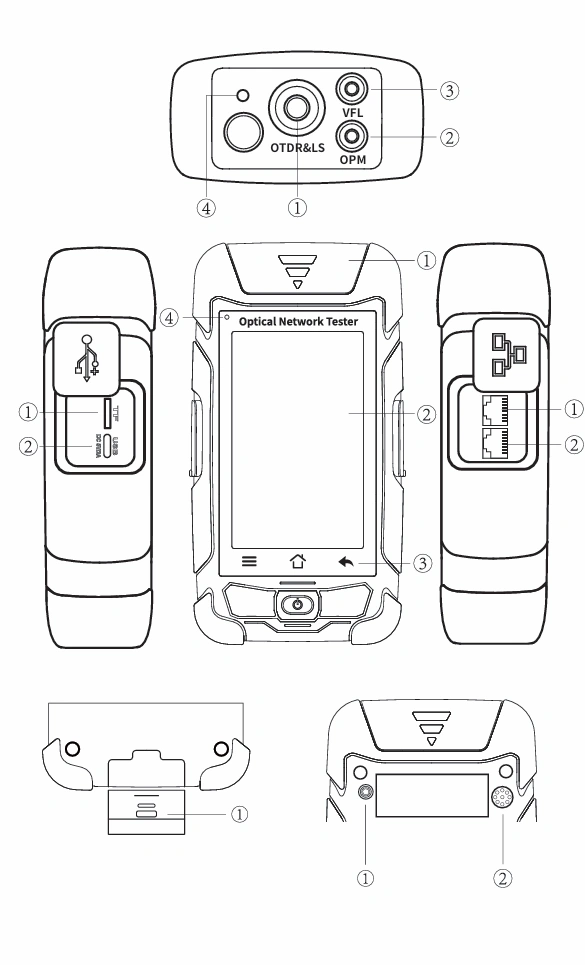
Top view Main view Left side
① OTDR/LS port ① Dust Cover ① TF Card Port② OPM port ② 4.3 inch Color LCD ② Type C USB③ VFL port ③ Function Keys④ Laser ranging port ④ LED Charging indicator
Right side Bottom view Back view
① RJ45 Tracker port ① RJ45 Remote tester ① Flashlight
② RJ45 Sequence port ② Loudspeaker
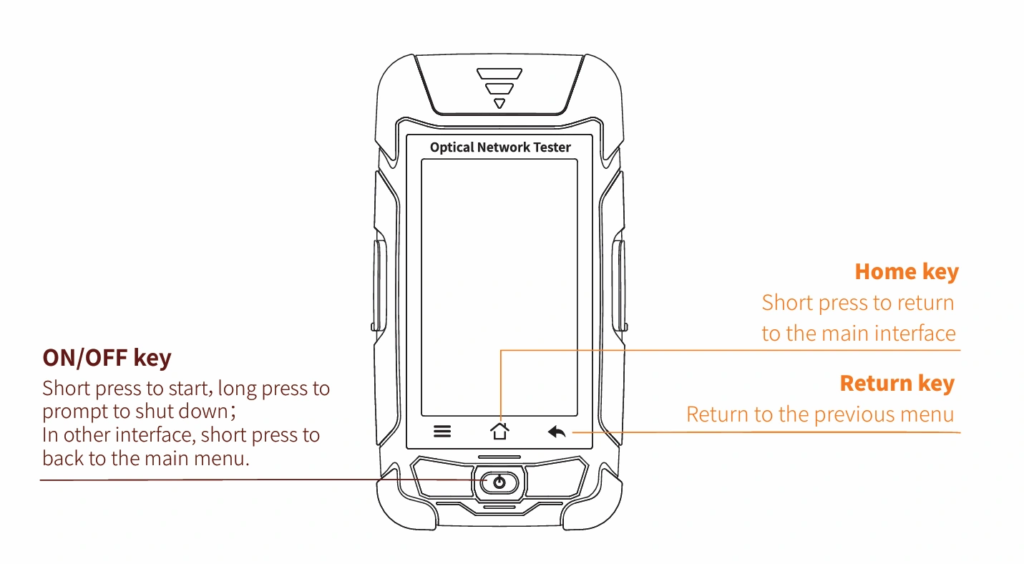
Touches de fonction
Interface principale
Turn on the instrument, enter the main menu, there are11 function modules, touch the icon to enter thecorresponding function interface.
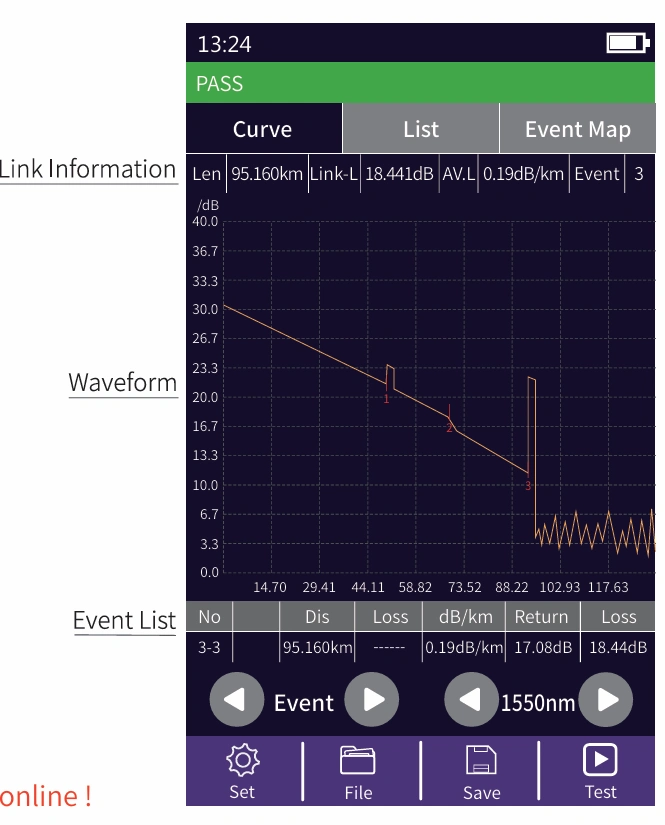
Auto OTDR
Auto OTDR: only need to set the wavelength,
other parameters are automatically selected.
Set: enter “Test setting” / “Pass/Fail” setting
interface
Test settings: set the wave, IOR and test time
Pass / Fail settings:
Avg. Loss Thre. : set the threshold of the
average link loss
Event Loss Thre. : set the loss threshold of
events in the link. If it is greater than this
threshold, it will be judged as fail, otherwise it
will be pass.
File: open the saved curve data
Save: the file is saved in the folder with the
name of the same day
Test: start OTDR automatic test
Attention
Besides 1625/1650nm, pls don’t test online!
OTDR-Setting menu
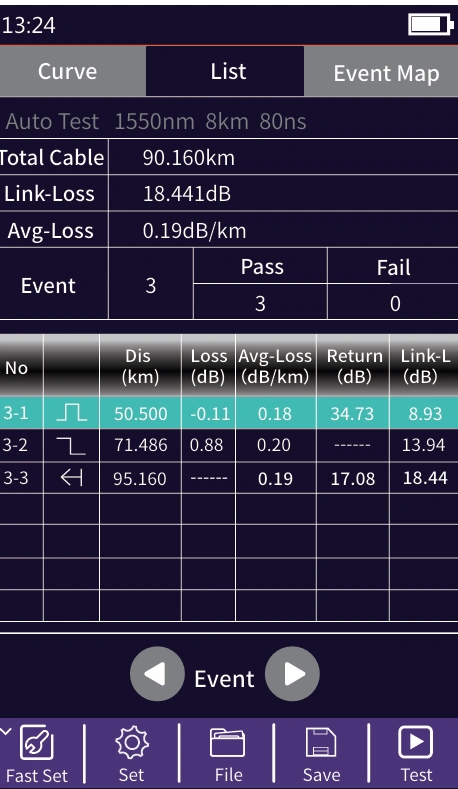
List: the test results are displayed in the form of a list.Cable length: the total length of the linkLink-Loss: the total loss of the linkAvg-Loss: the average loss of the linkEvent: the total number of events, passed numbers, failed numbersDans la liste des événements :NO.: the order of the current eventType: the type of the current eventDis: the distance of the current eventLoss: the loss value of the current eventAvg-Loss: the average loss value from the start to the current eventRL: the return loss value of the current event pointLink-L: the total loss from the start to the current event point
OTDR expert
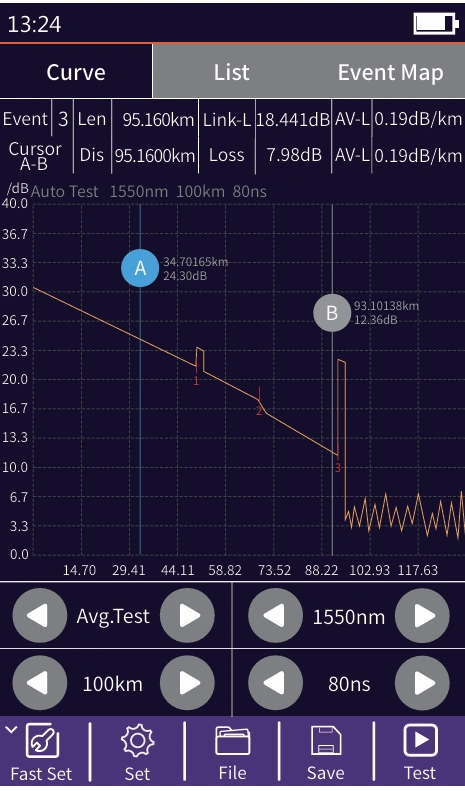
Expert OTDR: set parameters such as wavelength, range and pulse width.
FastSet: quickly set the test parameters of OTDR
Measurement mode: OTDR scanning event mode, AutoTest/RealTest/Avg.Test
Wavelength: select the test wavelength of OTDR
Test range: usually choose about 2 times of the length of the optical fiber to be tested
Test pulse width: 3ns ~ 20000ns optional, different range, the optional pulse width is different
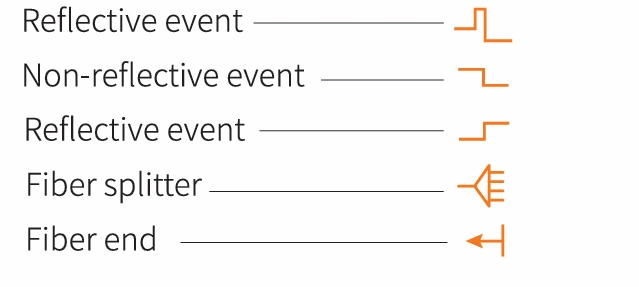
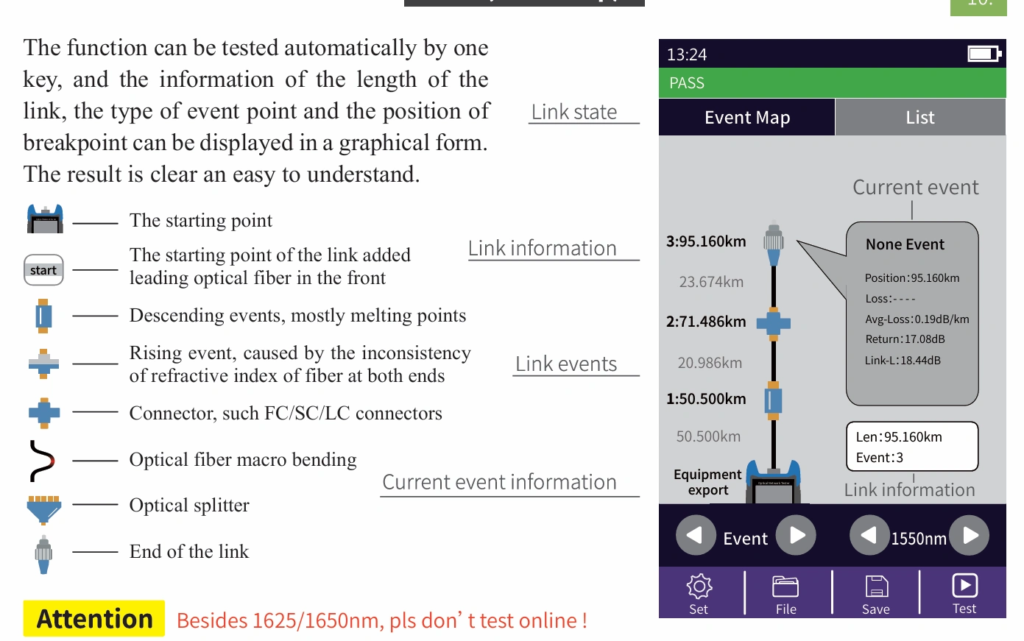
Il existe cinq types d'événements :
Réglages de l'OTDR
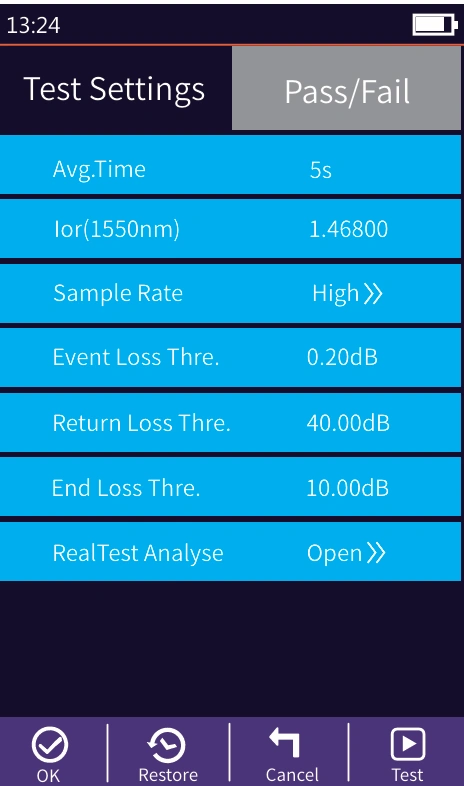
Set: Avg.Time and IOR are the same as those in Auto OTDR.Sample Rate: Standard: test with standard accuracyHigh: test in high precision mode, the testtime will be extendedEvent Loss Thre.: set the loss threshold of connection point,fusion point in the link that can be tested, between 0.2dB ~30dB, and the default value is 0.2dB. Loss value larger thanthe setting value will be listed in the event list, or it will beignored.Return Loss Thre.: set the return loss threshold of the linkreflection events that can be tested, ranging from 10dB to60dB, the default value is 40dB.End Loss Thre.: set the loss threshold at the end of link thatcan be tested, ranging from 1dB to 30dB, the default value is10dB.RealTest Analyse: turn on or off the automatic analysisOK: save the set parametersRestore: restore factory settings
OTDR-File Save
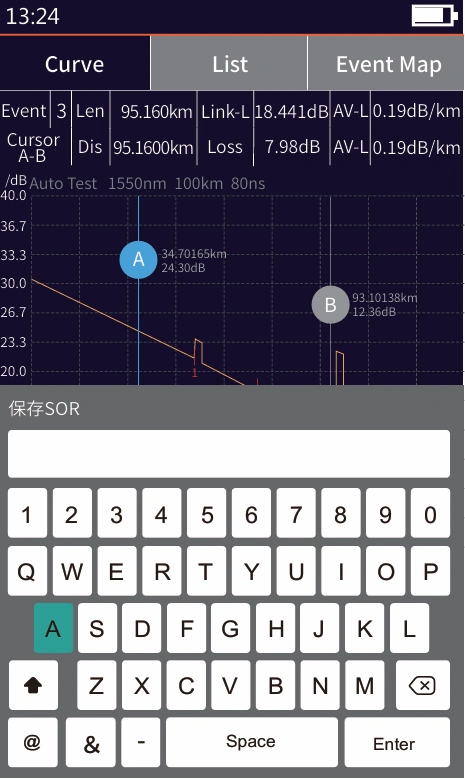
Press the 【Save】 key to save file after test complete, pop up the keyboard, enter the name of the file, and press Enter to save the file. If the automatic save (otdr) function is turned on in “System Settings”, it will be saved automatically after the test complete without manual operation.
Auto-save function
Enter the system settings, open the auto-saving function, the instrument will automatically save the test files after the average or auto-test.
OTDR-File Operation
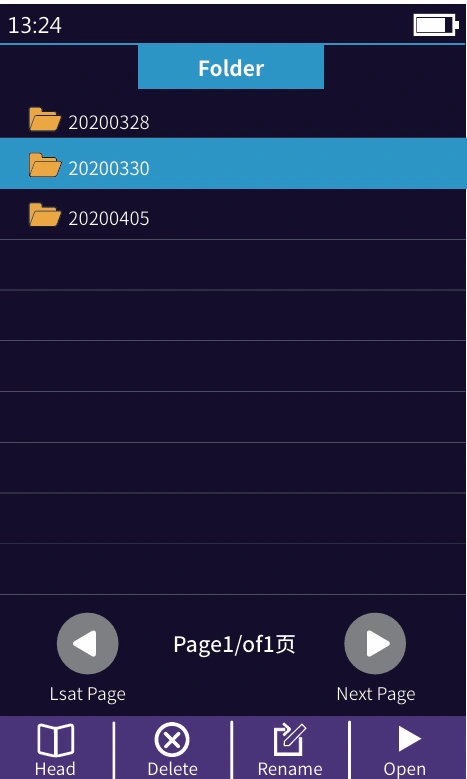
Press 【File】 to enter the file list.
Head: back to the first page
Delete: delete the current file or folder
Rename: change the name of the current file or folder
Open: open the selected file or folder
iLOM(Event Map)
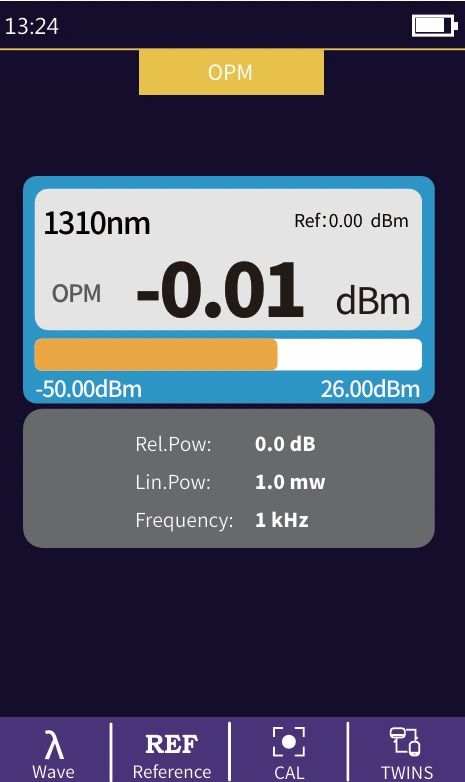
OPM
The function is used to test the power of optical signal
and insertion loss of various devices and optoelec
tronic components. It can identify and measure the
frequency of 270/330/1000/2000Hz optical signal.
Wave: switch the working wavelength
Reference: set current power as reference power
CAL: enter the user calibration mode and
calibrate with the standard light source
TWINS: identify the wavelength and frequency of the
tested laser source. This function is used with the twins
function of the local laser source-50~+26dBm: received power>-10dBm-70~+6dBm: received power>-30dBm
Absolute power, relative power andlinear power are converted as follows:PAbs.=10lgPLin./1mWPRel.=P Abs.-PRef.
VFL
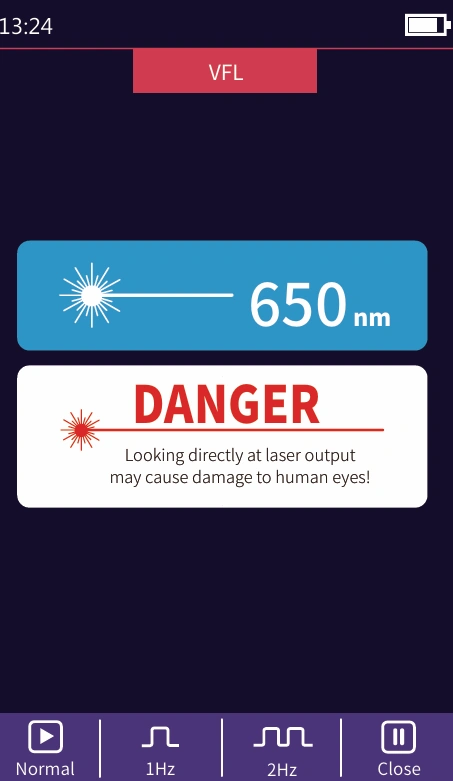
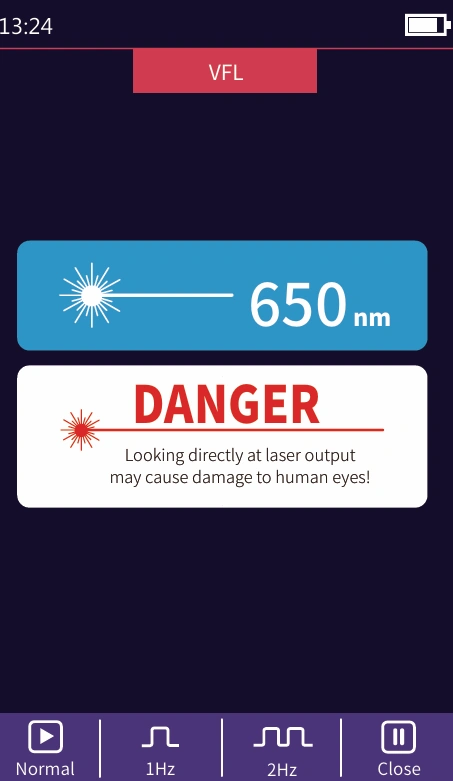
Visible red light (650 nm) is injected into theoptical fiber, and the position of the opticalfiber fault point can be judged convenientlyand accurately by observing the leakageposition on the measured fiber. It is suitablefor the detection of bare optical fibers,jumpers and other high loss sections causedby near-end faults and micro-bending ofoptical fibers and cables which can leak red lights.
Normal: turn on red light, continuous light
1Hz: red light source flashes once in 1 second
2Hz: red light source flashes twice in 1 second
Close: turning off red light
Avertissement
Looking directly at laser output may cause damage to human eyes!
Source laser
The wavelength of stabilized laser source is
the same as OTDR wavelength. It is used to
measure the parameters of telecommunica-
tion, CATV, LAN cable, insertion loss, isola-
tion loss and echo loss of optical passive
devices, and wavelength responsiveness of
detectors.
Open: turn on the laser source
Wave: switch the wavelength, the output
wavelength is consistent with OTDR
Mode: switch the modulation frequency of
light source, CW/270/330/1000/2000Hz
TWINS: enter the paired output mode. This
function is used with the twins function of
the local optical power meterWarning
Looking directly at laser output may cause damage to human eyes!
Source laser
The wavelength of stabilized laser source is
the same as OTDR wavelength. It is used to
measure the parameters of telecommunica-
tion, CATV, LAN cable, insertion loss, isola-
tion loss and echo loss of optical passive
devices, and wavelength responsiveness of
detectors.
Open: turn on the laser source
Wave: switch the wavelength, the output
wavelength is consistent with OTDR
Mode: switch the modulation frequency of
light source, CW/270/330/1000/2000Hz
TWINS: enter the paired output mode. This
function is used with the twins function of
the local optical power meterWarning
Looking directly at laser output may cause damage to human eyes!
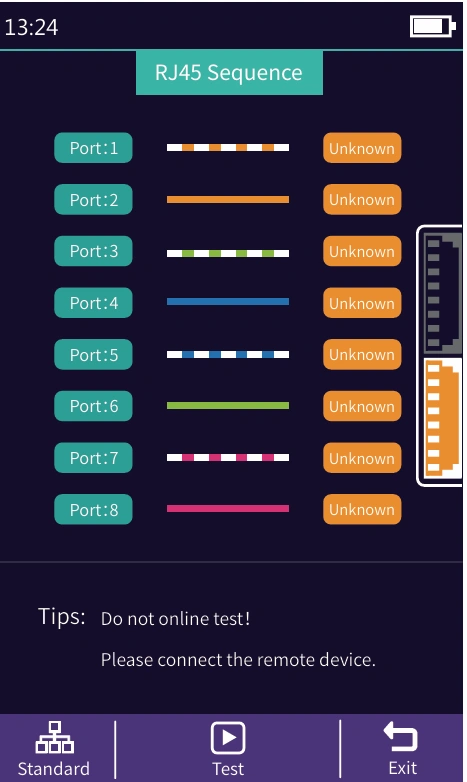
Séquence RJ45
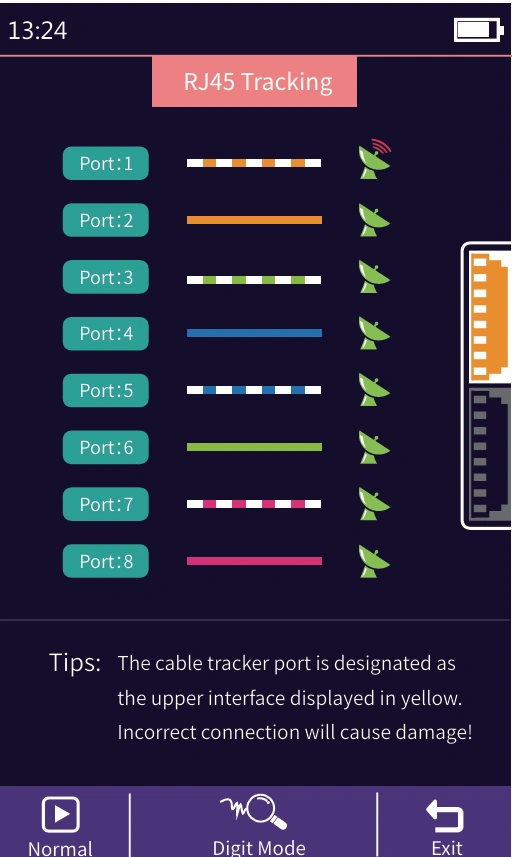
RJ45 line sequence measurement.
Measure the sequence of 8-core wires inside the network cable. Please connect to the remote module when measuring.
Standard: select different network cable standards
Test: start cable sequence test
Exit: exit the cable sequence test and return to the main interface
Avertissement
Please do not test online!
Attention
The cable length port is designated as the lower interface displayed in yellow. Incorrect connection will cause damage!
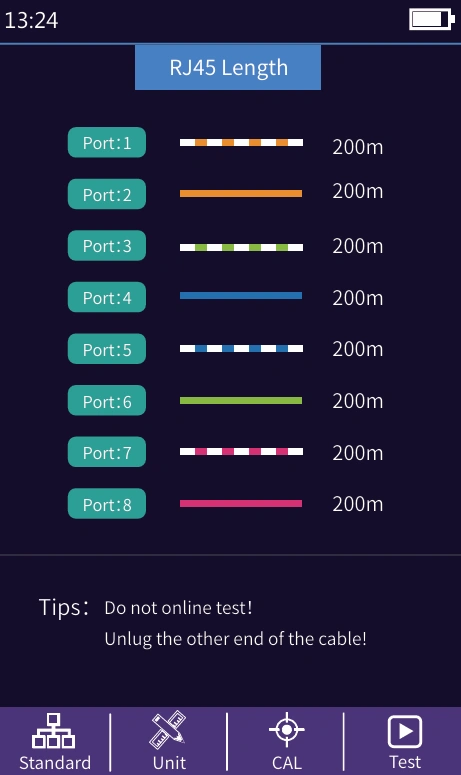
Longueur RJ45
RJ45 Length test:Test the length of the
network cable.
Standard: select different cable standards
Unit: switch different units
CAL: adjust the test result according to the
actual length, and display length = last test
result × correction
Test: start cable length test
Avertissement
Please do not test online!
AttentionThe cable length port is designated as the lower interface displayed in yellow. Incorrect connection will cause damage!
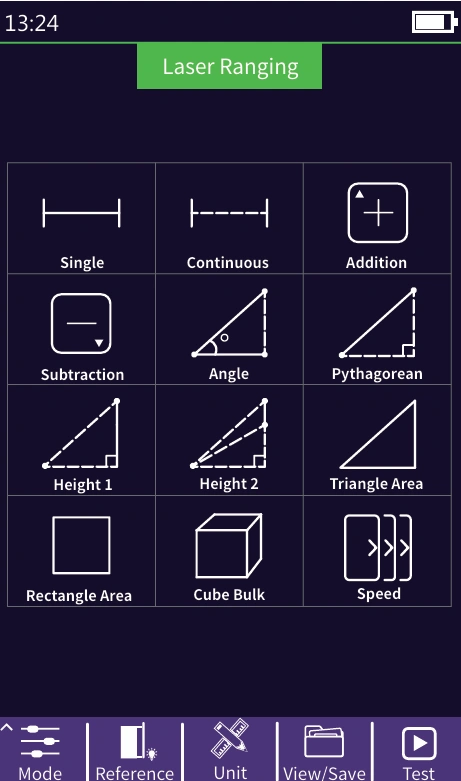
Laser Ranging
Laser Range: the maximum test distance is 40 meters
Mode:single/Continuous/Additio/Subtraction/An
gle/Pythagorean/Height1/Height2/Triangle
area/Rectangular area/Volume/Speed measurement
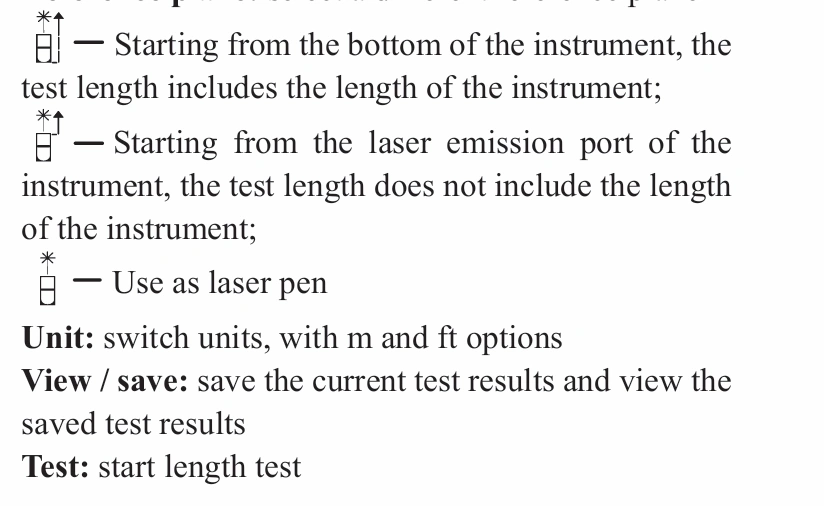
The solid line in the measurement mode icon is the
parameter to be tested
Reference plane: select a different reference plane
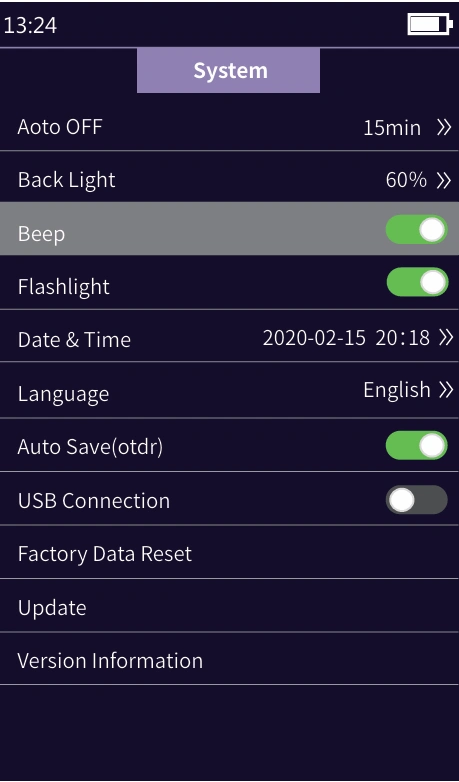
System settings
Auto OFF: Set auto shutdown time
Backlight brightness: Setting backlight brightness
Sound: turn the touch tone on or off
Flashlight: turn the flashlight on or off
Date & Time: set the instrument time and date
Language: displays the native language type
Auto Save: automatically save the curve file after
opening
USB connection: connect to the computer after
opening and transfer data
Restore factory settings: restore default parameter
values
Upgrade: software upgrade
Version information: view local information and
alarm records