Description
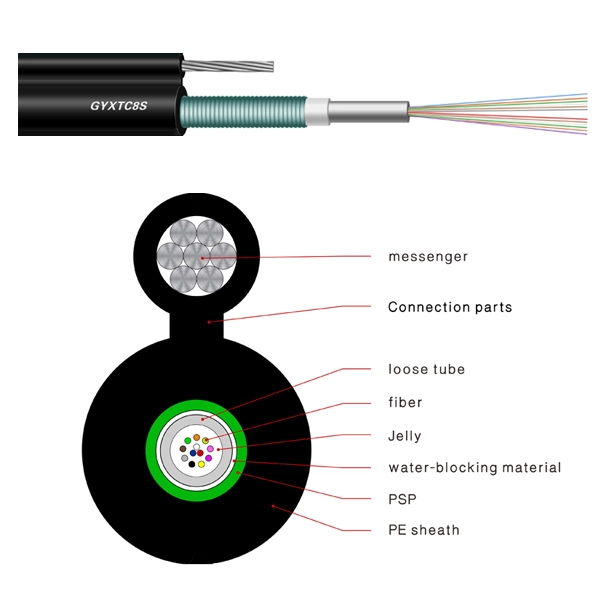
The fibers, 200/250μm,are positioned in a loose tube made of a high modulus plastic, the tubes are filled with a water-resistant filling compound. The two sides PSP are longitudinally applied over the outer loose tube. Steel wires and loose tubes filled with water proof compound to ensure compact and longitudinally water blocking ,this part of cable accompanied with the stranded wires as the supporting part are completed with a polyethylene(PE) sheath to be figure 8 structure.
Product Features
·Good mechanical and temperature performance
·High strength loose tube that is hydrolysis resistant
·Special tube filling compound ensure a critical protection of fiber
·PSP enhancing moisture-proof
·Small diameter, light weight and friendly installation
·Long delivery length and low price.
Product Standard
·GYXTC8S cable complies with Standard YD/T 1155-2011 as well as IEC 60794-1.
Optical Characteristics
| G.652 | G.655 | 50/125μm | 62.5/125μm | ||
| Attenuation (+20℃) | @850nm | ≤3.0dB/km | ≤3.0dB/km | ||
| @1300nm | ≤1.0dB/km | ≤1.0dB/km | |||
| @1310nm | ≤0.36dB/km | ≤0.40dB/km | |||
| @1550nm | ≤0.22dB/km | ≤0.23dB/km | |||
| Bandwidth (Class A) | @850 | ≥500MHZ·km | ≥500MHZ·km | ||
| @1300 | ≥1000MHZ·km | ≥600MHZ·km | |||
| Numerical Aperture | 0.200±0.015NA | 0.275±0.015NA | |||
| Cable Cut-off Wavelength λcc | ≤1260nm | ≤1480nm | |||
Technical Parameters
| Cable Type | Fiber Count | Cable Diameter mm | Cable Weight Kg/km | Supporting Wire Spec | Connection Diameter mm | Tensile Strength N | Crush Resistance N/100m | Bending Radius mm |
| GYXTC8S | 2~12 | 7.0×14.0 | 118 | ф1.0mm×7 steel strand | High * width 3.0×2.5 | 3500/7000 | 1000/3000 | 15D/30D |
| GYXTC8S | 14~24 | 8.0×15.1 | 129 | ф1.0mm×7 steel strand | High * width 3.0×2.5 | 3500/7000 | 1000/3000 | 15D/30D |
Storage/Operating Temperature : -40℃ to + 70℃
FAQ
Q1: What is the structural design and main application of the GYXTC8S Figure 8 Cable?
A: The GYXTC8S is a self-supporting outdoor aerial fiber optic cable featuring a figure-8 cross-section with an integrated stranded steel wire messenger. It encloses 200/250μm fibers inside a jelly-filled loose tube wrapped with Plastic-Coated Steel Tape (PSP) for moisture-proofing and encased in a durable Polyethylene (PE) sheath.
Q2: What industry standards does the GYXTC8S cable comply with?
A: The cable complies with telecom standard YD/T 1155-2011 as well as international standard IEC 60794-1.
Q3: What are the key performance features of this cable?
A: Key features include:
- High hydrolysis resistance in the loose tube material
- PSP armor for enhanced moisture protection
- Operating and storage temperature range from -40℃ to +70℃
- High tensile strength (3500 N long-term / 7000 N short-term) and crush resistance (1000 N/100m long-term / 3000 N/100m short-term)
- Compact, lightweight figure-8 design for simplified aerial installation
Q4: What core counts and physical dimensions are available for GYXTC8S?
A: Specifications by core capacity include:
- 2 to 12 Cores: 7.0 × 14.0 mm cable diameter | 118 kg/km weight | ф1.0mm × 7 steel strand supporting wire
- 14 to 24 Cores: 8.0 × 15.1 mm cable diameter | 129 kg/km weight | ф1.0mm × 7 steel strand supporting wire
Q5: What is the reference price, and how can I place an inquiry?
A: The reference price is $9 USD. You can click “Add to Quote” on the product page for custom volume pricing or “Request a Demo” for sample evaluation inquiries.