Présentation du produit
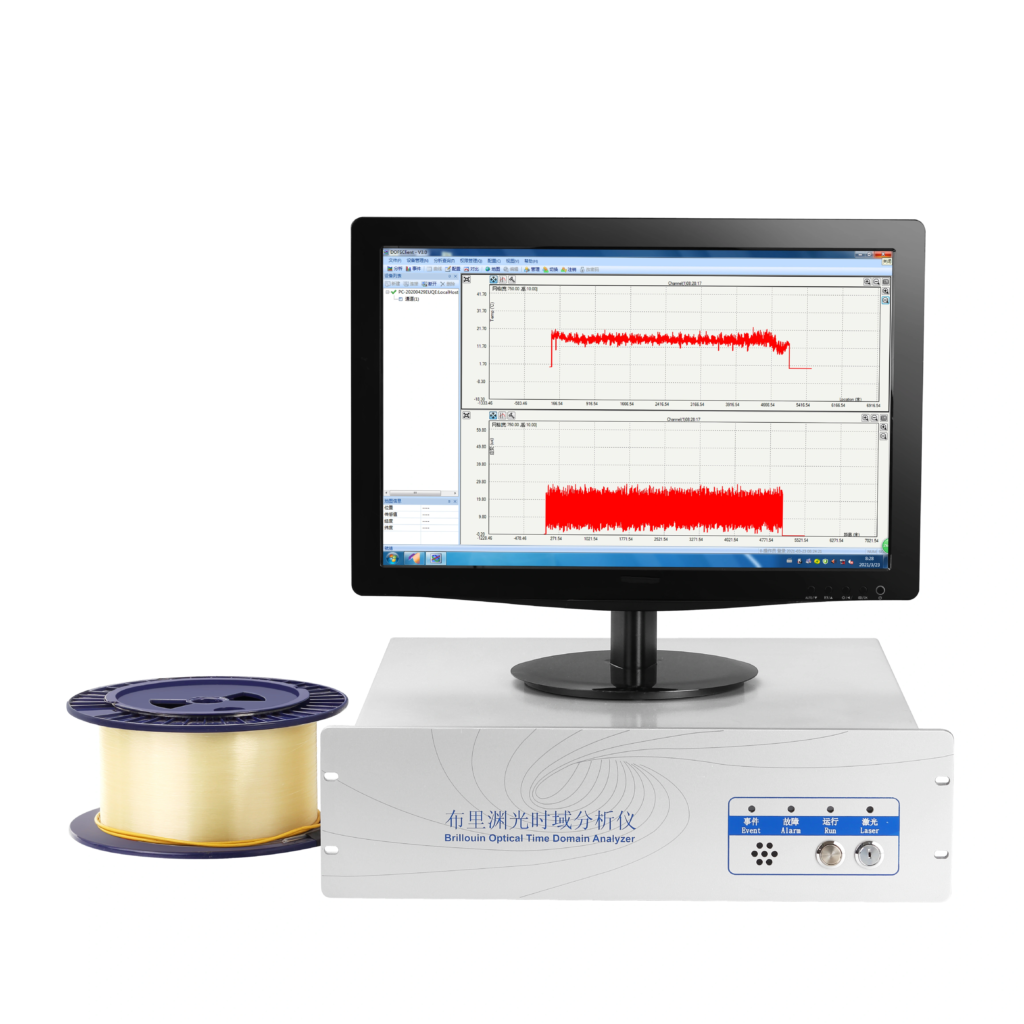
The Brillouin distributed fiber optic temperature and strain sensor BOTDA adopts internationally advanced Brillouin optical time-domain analysis technology and is a new generation of distributed sensors. This sensor uses ordinary communication single-mode optical fiber, which is both a transmission medium and a sensing element. By laying the optical fiber on the object to be measured, real-time temperature and strain distribution information of each point on the fiber can be obtained, achieving continuous online monitoring and precise positioning over long distances.
This BOTDA integrates high-tech such as optoelectronics, hardware, computer, and information processing, with a measurement distance of up to 100km, temperature measurement accuracy of 1 ℃, and strain measurement accuracy of 20 μ ε; At the same time, due to the use of optical signals as carriers, they are not affected by electromagnetic interference, are inherently safe, have a long service life, and are suitable for working in harsh environments. They have important applications in fields such as underwater optoelectronic composite cables, overhead power lines, long-distance oil and gas pipelines, bridges, dams, and geological hazard monitoring.
principe de mesure
When light is transmitted in optical fibers, scattering occurs due to the non-uniformity of the density and refractive index of the fiber material. Brillouin scattering is the process of light scattering caused by the interaction between light waves and sound waves propagating in optical fibers. When the ambient temperature changes or the optical fiber undergoes deformation, both the speed of sound and the refractive index of light in the fiber will change accordingly, resulting in a change in the Brillouin frequency shift, and the change in Brillouin frequency shift is linearly related to temperature and strain.
BOTDA is based on the stimulated Brillouin scattering effect, utilizing the interaction between pump light, probe light, and sound waves to continuously amplify the backward Brillouin scattering signal. Continuous scanning of the frequency difference between the pump light pump and the probe light probe can determine the Brillouin frequency shift at different positions of the fiber, thereby obtaining the temperature and strain distribution information of the entire fiber.
Technical advantages
- Continuous distributed temperature measurement without measurement blind spots
- La fibre optique est un capteur qui combine transmission et détection
- Measuring distance is long
- Single ended installation method, easy to install
- Can accurately locate the location of the fire
- Transmission de signaux optiques, entièrement isolée électriquement, résistante aux interférences électromagnétiques
- Fast measurement speed
- Sécurité intrinsèque, adaptée à une utilisation à long terme dans des environnements inflammables et explosifs
- Mesure stable et fiable avec un faible taux de fausses alarmes
Performance characteristics
- Real time distributed temperature and strain measurement
- Measurement distance: 5-100km
- Fast measurement time: as low as 20 seconds
- High measurement accuracy: 1 ℃, 20 μ ε (0.002%)
- Logiciel convivial doté d'une interface visuelle
- High spatial resolution: 0.5-3m