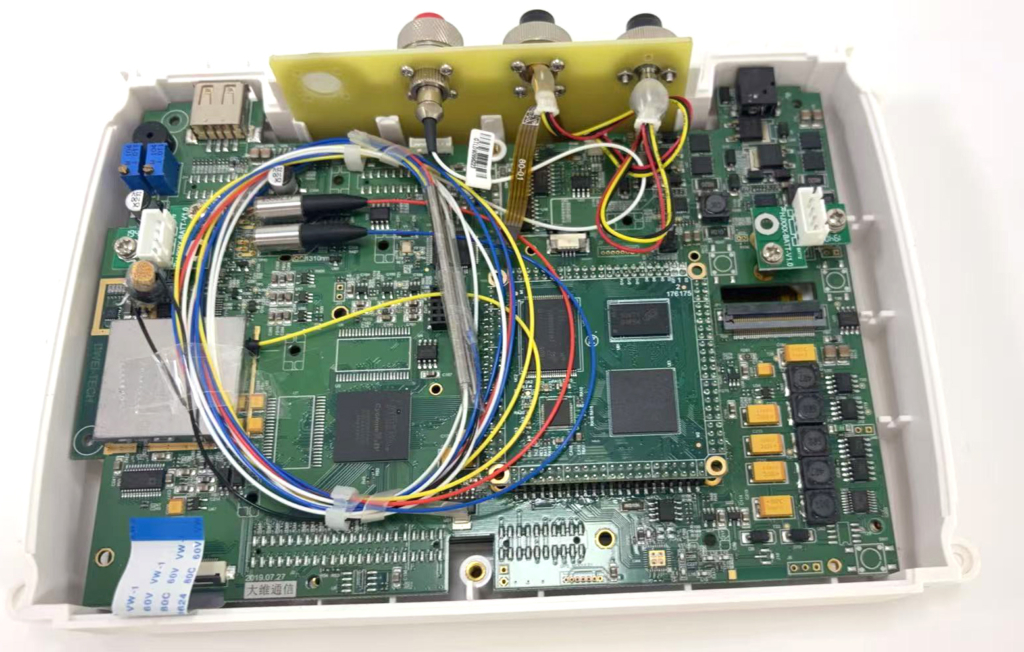
The research and development of modern Optical Time-Domain Reflectometers (OTDR) has long evolved beyond simple optical-to-electrical conversion, transforming into an extreme microscopic balancing act among quantum noise limits, picosecond-level clock domains, non-linear optical physics, and ill-posed mathematical inverse problems. With the introduction of coherent detection, single-photon counting, and heterogeneous photonic integration, OTDR technology is at a turning point, leaping from “macroscopic bulk measurement” to “microscopic quantum state and optical field detection.”
Core R&D Challenges Deep within Physics and Silicon Foundations
The Physical Limits of the Analog Front-End (AFE): The Deadlock of Thermal Noise, Shot Noise, and Gain-Bandwidth Product
The OTDR receiver faces an extreme dynamic range, stretching from (saturation from Fresnel reflections) down to or even lower (deep Rayleigh scattering). The true barrier lies in the “deadlock” when the AFE approaches physical limits:
The Parasitic Pole Paradox of TIAs: To suppress the thermal noise current of the Transimpedance Amplifier (TIA), the feedback resistor must be vastly increased. However, , coupled with the APD junction capacitance and the op-amp input parasitic capacitance , creates a low-frequency pole . With often reaching several , improving sensitivity inevitably sacrifices bandwidth (elongating spatial resolution). Utilizing circuit topologies like Inductive Peaking or Bootstrapping to offset parasitic capacitance remains a highly challenging analog IC design problem.
Deep-Level Traps in APDs and Active Clamping: The strong-reflection dead zone cannot be resolved merely by shortening the system bandwidth. When an InGaAs/InP APD encounters intense light, “Deep-Level Traps” in the InP multiplication layer capture and slowly release hole carriers, forming a “Tailing Effect” that is physically impossible to eliminate directly. Traditional passive clamping with Schottky diodes has reached its bottleneck. It is necessary to introduce Active Quenching circuits with sub-nanosecond response times, or even dynamically pull down the APD bias voltage () during strong reflections to quench the avalanche.
The “Unipolar” Dilemma and Non-Linear Distortion in Optical Pulse Coding
To break the contradiction between dynamic range and spatial resolution, introducing orthogonal codes like Golay or Simplex is an industry consensus. However, unlike radio frequency microwaves that can possess positive and negative amplitudes, direct detection optical intensity is inherently unipolar ().
The Devastating Impact of Extinction Ratio (ER) and Thermal Drift: Implementing complementary Golay codes typically requires transmitting Code and its complement . If the extinction ratio of the semiconductor laser (LD) or external Mach-Zehnder Modulator (MZM) is insufficient, or if the baseline optical power drifts by even during transmission due to self-heating effects, the cross-correlation sidelobes of the orthogonal codes cannot return to zero. These residual sidelobes manifest as dense “ghost steps” on the OTDR trace, which not only fail to improve the dynamic range but completely destroy the linearity of the testing baseline.
The Ill-Posed Inverse Problem in DSP Algorithms
Using deconvolution in software to compress the dead zone is mathematically equivalent to solving a Fredholm integral equation of the first kind:
This is a typical ill-posed inverse problem: the system transfer function often decays exponentially in the high-frequency domain, while the noise is broadband and uniformly distributed.
When performing the inverse operation in the frequency domain, minute thermal noise in the high-frequency region is amplified thousands of times.
Even with the introduction of Wiener Filtering or Tikhonov Regularization, the adaptive optimization of the regularization parameter is extremely difficult. In complex PON networks, the amplitude and spacing of reflection peaks change dynamically and dramatically. A fixed either fails to compress the dead zone or triggers massive, false Ringing peaks on the trace.
Next-Generation Paradigms Breaking Traditional Boundaries
Evolution from Intensity to Optical Field Detection: Coherent OTDR (C-OTDR) and Rayleigh Fading Compensation
As direct detection approaches the shot-noise limit, introducing a Local Oscillator (LO) for coherent detection becomes inevitable. Utilizing heterodyne interference, C-OTDR can improve the SNR by over compared to direct detection, easily penetrating thousands of kilometers of submarine cables.
Core Opportunities and Challenges: The absolute difficulty of coherent systems is Rayleigh Fading. Due to the high coherence of the light, micro-scattering centers within the fiber cause random coherent interference, resulting in Speckle Noise that can be tens of dBs deep. R&D teams must adopt Frequency-stepped Pulses or Chirped Pulses, performing spectral orthogonal demodulation and incoherent averaging in post-processing DSP. This transforms the troublesome fading noise into highly valuable Distributed Acoustic/Vibration Sensing signals, directly expanding the OTDR market from telecom testing to security perimeters, seismic monitoring, and the Industrial IoT.
A Dimensional Strike from the Quantum Limit: Single-Photon OTDR (SPAD/TCSPC)
By utilizing Single-Photon Avalanche Diodes (SPAD) and Time-Correlated Single-Photon Counting (TCSPC) technologies, the OTDR’s reception mechanism is completely shifted from “analog current integration” to “discrete quantum statistics.”
- Mechanism Revolution: SPAD operates in Geiger Mode, outputting a standard logic level upon absorbing a single photon. The trace is reconstructed by compiling a histogram of the Time of Flight (TOF) of the arriving photons.
- Core Advantages: It completely eliminates the thermal noise of AFE analog circuits and the amplifier recovery dead zone, theoretically achieving a Zero Dead Zone and over a dynamic range with centimeter-level resolution. Current R&D challenges involve overcoming the non-linear distortion caused by the Pile-up effect due to the SPAD’s Dead Time, and the ASIC integration of high-speed Time-to-Digital Converters (TDC).
Heterogeneous Photonic Integrated Circuits (PIC): The Ultimate Form of eOTDR
Cramming a benchtop OTDR into a standard SFP optical module to enable “native self-diagnostics for network equipment” is an absolute future trend.
Integration Process Barriers: Pure Silicon Photonics cannot emit light, nor can it implement high-performance APDs. R&D must overcome heterogeneous integration challenges: integrating InP lasers, SOAs (Semiconductor Optical Amplifiers), and SiGe APDs onto the same substrate via micro-interposers or wafer-level bonding. Solving thermal management for lasers in extremely small packages and mitigating optical crosstalk (up to tens of dBs) between the transmitter and receiver will be the primary battleground for hardware teams over the next three years.
Physics-Informed Neural Networks (PINN) for Waveform Reconstruction
For complex PON network topologies, traditional threshold-based peak-finding algorithms have reached a dead end. Direct application of “black box” deep learning easily leads to inexplicable errors. The future algorithmic opportunity lies in Physics-Informed Neural Networks (PINN): incorporating the mathematical constraints of the Rayleigh attenuation equation and the Fresnel reflection equation into the Loss Function of a 1D-CNN. This requires the algorithm not only to “recognize” waveforms but also to strictly adhere to energy conservation and physical optical laws. This significantly improves the recognition accuracy of complex events (such as cascaded splitters) and leverages AI to unearth predictive features of microscopic fiber stress variations from a massive noise floor.
Two Decades of Deep-Tech Expertise and Custom Empowerment
Leveraging over 20 years of experience in core OTDR algorithms, ultra-weak signal processing, and optoelectronic manufacturing, the FirstFiber Technologies team has successfully bridged the gap between theoretical models and engineering implementation. In the face of generational technological evolution, the team is dedicated to providing industry clients with professional, customized services—ranging from DSP algorithm licensing to photonic architecture optimization—working together to explore the next technological singularity of all-optical networks.