Abstract
In‑service fibre diagnostics are essential for operators rolling out 10G‑PON alongside existing GPON subscribers. Traditional 1625 nm out‑of‑band OTDR measurements are often degraded by Raman noise and filter crosstalk when fibres carry live 1490 nm downstream signals, producing noisy traces and spurious reflective events. This article examines the physical limitations of 1625 nm probing wavelengths within mixed‑generation PON plants, analyses the fundamental optical trade‑offs of adopting 1650 nm as an alternative test band, and summarises practical operational constraints observed during large‑scale live‑network field trials. The discussion provides guidance for defining test requirements for NG‑PON2 and future multi‑wavelength fibre access deployments.
1. Introduction
Fibre access infrastructure commonly supports multiple PON standards over a single physical fibre. When operators deploy XGS‑PON (10G‑PON), existing GPON services must remain active, meaning the fibre concurrently transports 1490 nm downstream GPON signals alongside new 10G‑PON wavelength channels. Fault localisation and link verification must therefore rely on out‑of‑band test wavelengths that do not interrupt live subscriber traffic.
The 1625 nm band has long been adopted for GPON field maintenance. However, when this probe wavelength shares fibre with high‑power 1490 nm downstream traffic, two degradation mechanisms emerge: residual leakage of service wavelengths through WDM filter ports, and Raman scattering induced by the in‑band optical signal. Both create measurement artefacts, including elevated trace noise and ghost events, which reduce confidence when locating splices, connectors and passive splitter ports.
To achieve greater spectral separation from all active PON signal bands, some network planners have identified 1650 nm as a candidate out‑of‑band test wavelength. At 1650 nm, sufficient guard‑band isolation is maintained for 1270 nm, 1490 nm and 1577 nm traffic, while the band remains compatible with measurements through high‑ratio splitters up to 1:64. Even so, shifting test operation to 1650 nm introduces intrinsic optical penalties that must be addressed within field‑hardened test hardware.
Despite widespread deployment of co‑existing GPON and 10G‑PON networks, formal industry guidelines specifying preferred out‑of‑band test wavelengths for hybrid environments remain incomplete. Most regional operator test specifications still default to 1625 nm procedures designed for single‑generation GPON plant, without accounting for Raman noise thresholds caused by 10G‑PON high‑power downstream channels. This creates inconsistent field measurement quality across modern fibre access deployments.

2. Fundamental optical trade‑offs for 1650 nm field OTDR implementation
The primary limitation of 1625 nm testing on live 10G‑PON links originates from stimulated Raman scattering (SRS). The 1577 nm high‑power XGS‑PON downstream signal acts as a pump laser, generating downshifted Raman photon noise precisely within the 1620–1630 nm OTDR test window. The resulting noise floor increases non‑linearly with launch power and fibre length, producing random reflective artefacts that cannot be filtered by conventional digital averaging alone.
Relative to 1625 nm, 1650 nm exhibits lower Rayleigh back‑scattering efficiency and slightly higher intrinsic fibre attenuation. Both effects reduce the achievable dynamic range, the primary performance metric for testing loss‑limited splitter‑based PON distribution networks. Three core design considerations govern viable field instrumentation:
- Stable narrow‑linewidth laser source: The transmitter must deliver usable probe power while remaining within Class 1 eye‑safety limits. Output power stability across temperature cycles is required to maintain trace repeatability in uncontrolled outside‑plant environments.
- Low‑noise optical receiver front‑end: Avalanche‑photodiode receiver circuits and multi‑stage amplification are necessary to recover weak reflected signals after attenuation by cascaded PON splitters. The receiver noise floor must be controlled to preserve spatial resolution for closely spaced reflective events.
- Digital signal processing: Noise suppression algorithms and dead‑zone mitigation logic are critical for MDU deployments, where many connectors and splices appear within a short fibre span.
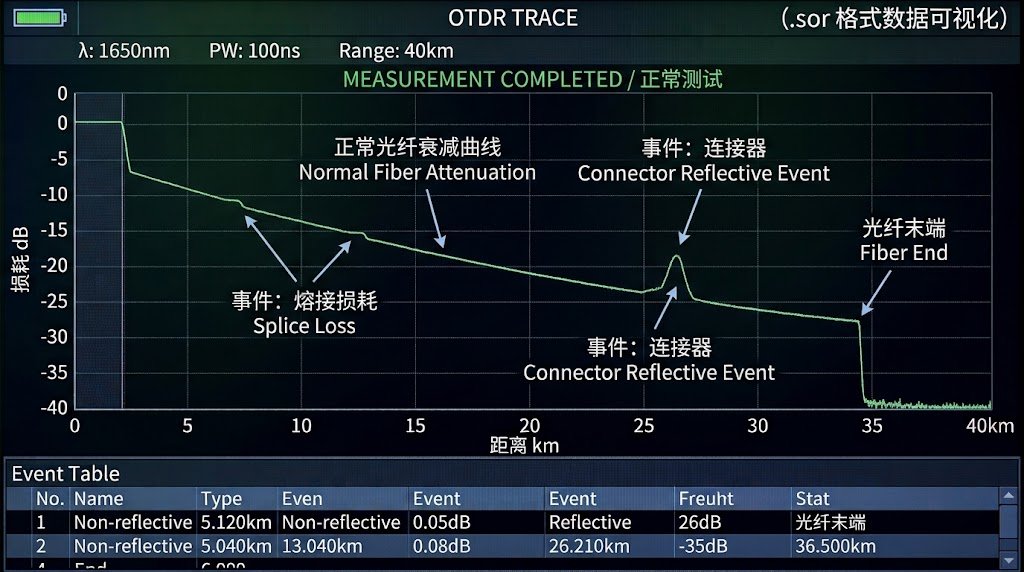
When these constraints are addressed in hardware and firmware, a 1650 nm OTDR platform can deliver greater than 37 dB dynamic range and sub‑1 m event dead‑zone, suitable for fault mapping across typical 10G‑PON distribution architectures.

3. Operational constraints observed during live‑network trials
Bench performance alone does not guarantee suitability for field workflows. Trials across urban, suburban and MDU live PON environments highlighted two practical limitations common to outside‑plant test instruments, independent of the underlying optical architecture.
First, conventional display panels suffer poor contrast under direct solar illumination. For technicians working at street cabinets and overhead splice points, reduced trace legibility slows fault diagnosis. Any field instrument intended for this use case must prioritise sunlight‑readable display characteristics.
Second, high‑density PON acceptance and maintenance programmes require technicians to evaluate large volumes of fibre links per shift. Repeated manual cursor placement to extract basic metrics such as fibre length and total loss creates unnecessary overhead. Automated event detection and metric reporting can streamline these high‑throughput test workflows.
Within the trial environment, measurements at 1650 nm were completed without disruption to co‑located live PON services, and the test architecture was compatible with centralised automated fibre monitoring interfaces.
4. Discussion & outlook
As NG‑PON2 and 25G‑PON deployments expand, coexistence of multiple service wavelengths on shared fibre will become standard practice. Selection of out‑of‑band test bands must be evaluated against the full set of active channels to preserve adequate spectral guard bands.
The 1650 nm band offers clear isolation advantages for mixed PON networks, yet it is not a universal replacement for 1625 nm. Higher fibre attenuation limits maximum reach on long feeder spans, and component availability together with system cost remain practical limiting factors for some operators. Instrument designers must balance raw optical performance with field usability requirements, including display visibility, automated analysis and compatibility with monitoring platforms.
In practical field conditions, 1625 nm OTDR traces on active 10G‑PON fibres typically exhibit noise floor elevation of 6 dB to 12 dB compared to dark fibre testing. This noise margin is sufficient to obscure low‑loss splice events and weak connector reflections, which are critical for preventive maintenance. In contrast, the 1650 nm offset provides approximately 25 nm of spectral isolation from the Raman noise band, eliminating the majority of in‑service measurement degradation.
The operational findings from 10G‑PON live trials demonstrate that wavelength selection is only one part of the test specification. Real‑world usefulness depends equally on accounting for field workflow constraints, which are often not captured in lab‑based component characterisation. These considerations can inform hardware requirements for next‑generation access network test systems.
As NG‑PON2 and 25G‑PON systems begin commercial rollout, overlapping wavelength coexistence will become even more complex. Test wavelength selection criteria demonstrated in this article can support the update of operator standard operating procedures and contribute to more robust field validation frameworks for next‑generation multi‑band fibre access networks.
5. 1650nm OTDR models from FirstFiber Technologies
| Model | Wavelength | Dynamic Range |
|---|---|---|
| 8000MAX-T3 | 1310/1550/1650nm | 35/33/32dB |
| 8000MAX-10G2 | 1310/1550/1270/1577/1650nm | 37/35/35/35/35dB |
| 980EXP-B32 | 1650nm | 32dB |
| FF-990PRO-PS2 | 1650nm | 38dB |
| FF-990PRO-PT4 | 1310/1550/1650nm | 38/36/36dB |
| 980RTC-B26 | 1650nm | 26dB |
| 980RTC-T3 | 1310/1550/1650nm | 24/22/22dB |
Ckeck all OTDR models.