In our previous blog post, we detailed the hardware components that make up the FirstFiber Technologies optical cable monitoring system and how we are streamlining physical deployments. In this post, we are shifting our focus from hardware to software—specifically, the powerful algorithms driving our system.
(Please note: While many of these features are currently active, certain advanced algorithmic functions discussed below are still in active development by our engineering team).
How the Algorithm Unscrambles the Data
When you remove the physical optical switch from an OTDR monitoring system, you replace it with a passive optical splitter. While this eliminates the bulky hardware, it creates a complex data problem that only advanced digital signal processing can solve.
Here is exactly how the software steps in to replace mechanical hardware,
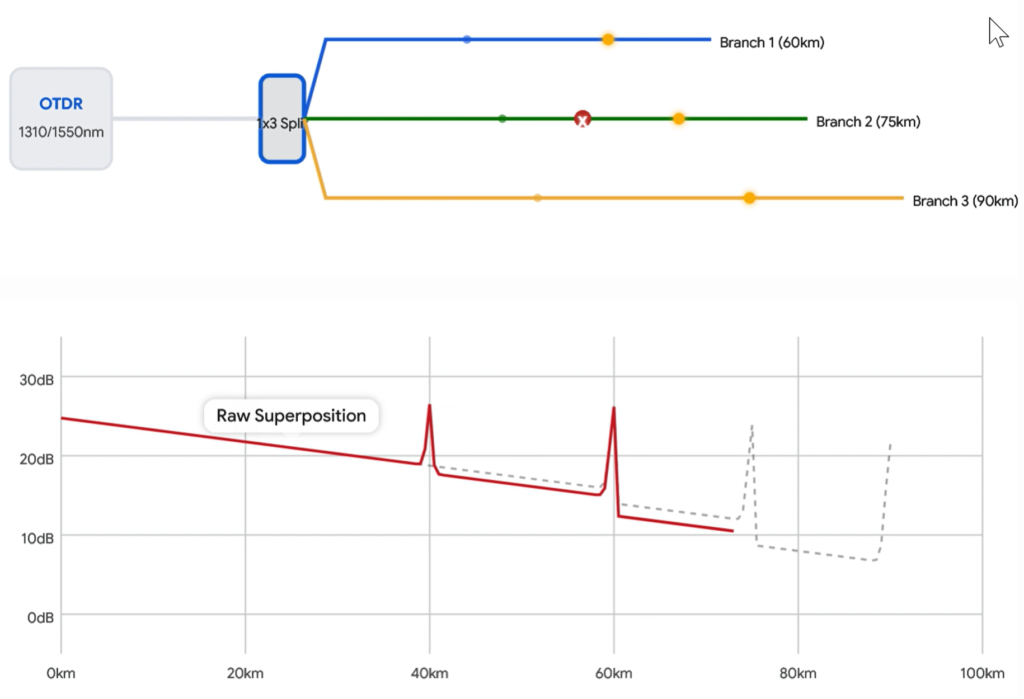
The Challenge: The Overlapping Trace
In a traditional setup, an optical switch physically connects the OTDR to Fiber A, runs a test, and then mechanically clicks over to Fiber B. It tests one line at a time, resulting in clean, isolated data.
Without a switch, a single OTDR pulse hits a passive splitter and travels down all connected fiber branches simultaneously. The backscatter and reflections from every single branch bounce back and mix together at the detector. To a standard OTDR device, this returning signal looks like chaotic, unreadable noise.
The Solution: FirstFiber Technologies’ 3-Step Processing
To make sense of this mixed signal, the system relies on high-speed data processing and proprietary logic—including FirstFiber Technologies’ Landmark Anchoring algorithm—to isolate faults.
- Baseline Fingerprinting (The Reference Map) When the system is first deployed, the algorithm records a highly detailed reference trace of the entire passive network while it is completely healthy. It identifies and maps known physical landmarks (like splice points, terminal connectors, and splitters) across every branch, creating a digital fingerprint of the network’s normal state.
- Signal Deconvolution (Subtraction) When a fault occurs—such as a cable cut or a micro-bend—the OTDR receives a new, slightly altered mixed trace. The algorithm dynamically overlays this new, chaotic trace against the healthy baseline fingerprint. Using complex math (deconvolution), it mathematically subtracts all the “normal” background reflections. What remains is only the isolated signal spike caused by the fault.
- Signature Recognition and Mapping Once the anomaly is isolated, the algorithm analyzes its shape. A degraded splice reflects light differently than a clean break or a tension bend. By calculating the exact distance of this new anomaly and cross-referencing it with the known landmarks from the baseline, the algorithm can confidently deduce exactly which branch the fault occurred on—even though the physical signal was never separated.
See the Difference
Explore this interactive visualization to see how an algorithm isolates a fault from a messy, passively split signal compared to the old method of mechanical switching.
The Reality Check: Trade-offs of the Algorithmic Approach
While replacing physical optical switches with a passive splitter and advanced algorithms sounds like a perfect solution, engineering is always about trade-offs. The FirstFiber Technologies engineering team believes in complete transparency regarding where this system excels and where it faces limitations.
Less Intuitive Data Visualization
Traditional switching systems provide a clean, isolated trace for each branch. A splitter-based system, even with excellent deconvolution algorithms, fundamentally relies on interpreting overlapping signals. It lacks the raw, intuitive clarity of a single-line test.
High Dynamic Range Requirements
Because the signal must punch through a passive splitter (which inherently causes massive insertion loss) and bounce back, the core OTDR module requires an exceptionally high dynamic range to “see” the end of the line clearly.
Algorithmic Complexity
The logic required to untangle the overlapping reflections is highly complex. If the baseline fingerprint of the network changes naturally over time, the algorithm must be meticulously updated to prevent false positives.
No Selective Branch Testing
A passive splitter means you are always testing all connected branches simultaneously. Unlike a mechanical switch, you cannot isolate and test just one specific branch on demand.
Traditional Methods Still Win on Raw Accuracy
Despite advanced software, when maximum precision and signal clarity are the absolute priorities, a traditional OTDR combined with a physical optical switch still delivers superior raw performance.
The Verdict: Which Should You Choose?
So, does the FirstFiber algorithmic approach replace traditional systems entirely? No.
In Non-PON Environments
For dedicated, high-value optical links where optical splitters don’t naturally exist, we still highly recommend the traditional approach: an OTDR paired with an optical switch. The clarity, reliability, and precision of this method remain unmatched.
In PON Environments (Passive Optical Networks)
Because PON architectures naturally utilize passive optical splitters to distribute signals, introducing mechanical switches adds unnecessary complication. Here, both approaches are viable, but the FirstFiber Algorithmic System shines brightest, allowing you to monitor the network using its existing passive architecture without adding bulky hardware.
At FirstFiber Technologies, our technical team is committed to continuously optimizing our algorithms. Our goal remains the same – to solve as many complex network problems as possible using the fewest hardware resources necessary, giving operators the best tools for their specific architecture.
What do you think about the shift from hardware switches to algorithmic monitoring? Have you deployed similar optical fiber monitoring systems in your network? Leave your thoughts and suggestions in the comments below…